
The Truth: IDPs Only Govern the Apps They Touch (And That’s Not Enough)
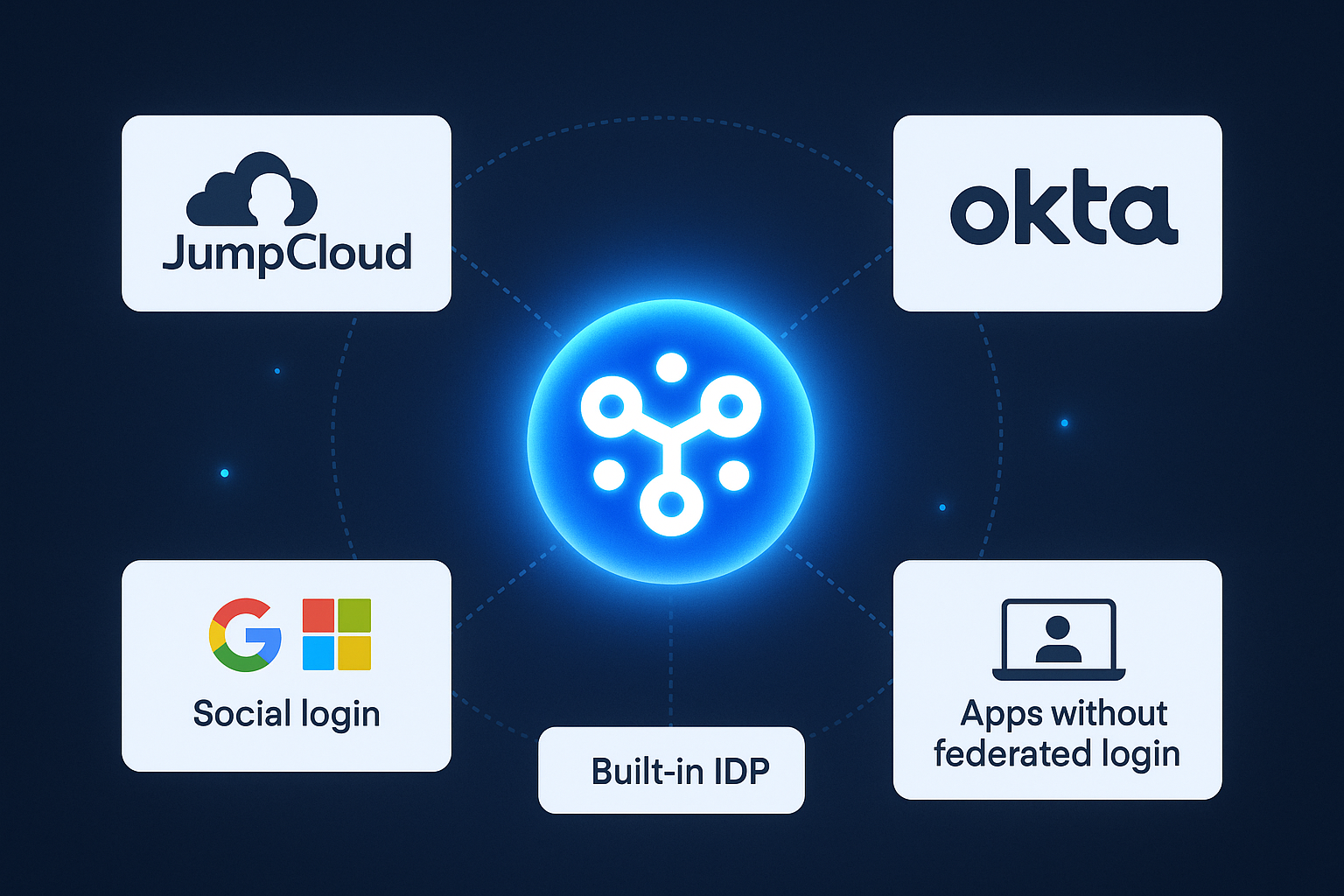
Most companies that choose JumpCloud, Okta, or Microsoft Entra believe they have “identity covered.” They picture a single login, a single control plane, and a single place to manage access. That used to be true when every important application supported SAML and SCIM. But that is not the world we live in anymore.
Modern companies now authenticate, approve access, and exchange data across multiple identity surfaces. And the core IDP no longer sees — or governs — most of the stack.
This is why IT and Security teams increasingly add an Identity Orchestration layer like YeshID on top of their IDP. Not to replace JumpCloud or Okta, but to fill the gaps those platforms were never designed to address.
This is the new identity reality.
The Modern Stack No Longer Has One IDP — It Has Three to Five
Five years ago, everything mission-critical ran through a single IDP. Today, an average mid-market company uses multiple login paths:
1. JumpCloud or Okta for SAML apps
Great for enforcing MFA, strong authentication, device trust, and SSO — but only works for the apps that actually support SAML.
2. Google and Microsoft for “social login”
This is how most teams adopt new tools. Marketing, Product, Finance, HR — they all click “Sign in with Google.” New AI companies default to OAuth, not SAML. Startups launching in 2024–2026 often never implement SAML at all.
3. Built-in IDPs for platform ecosystems
AWS, GCP, Atlassian, Salesforce, and others often bring their own identity layers for plugins and internal modules.
4. Apps without any federated login
Contractor systems, point solutions, older tools, niche SaaS — these stay username/password and live entirely outside the IDP perimeter.
Result:
Your IDP governs only the slice of your world that happens to use SAML + SCIM. And for most companies, that’s about 30 percent of the stack.
Everything else is invisible.
Authentication ≠ Access Management
JumpCloud and Okta were built as authentication control planes — not as systems of record for every permission, role, or OAuth grant happening across your environment.
They excel at:
- MFA
- Conditional access
- SSO
- Device trust
- Strong authentication workflows
But they do not manage:
- OAuth-based apps
- “Sign in with Google/Microsoft” adoption (shadow onboarding)
- Internal permission changes inside each app
- App-to-app OAuth connections (MCP, AI agents, integrations)
- SaaS sprawl from non-IT teams
- Drift in permissions after the initial provisioning
- Evidence and audit of who actually has what access across all systems
You can force everything to become a SAML app — but that means:
- Paying the SSO tax everywhere
- Slowing down teams
- Blocking adoption of tools that do not support SAML
- Losing the benefits of modern OAuth ecosystems
- Frustrating business units that want autonomy
Most companies decide not to fight this battle.
So the gap grows.
The Core Problem: Your IDP Only Governs the Apps It Touches
Think about a policy like:
“Only engineers should have access to production tools.”
If 30 percent of those tools authenticate through JumpCloud or Okta and 70 percent authenticate some other way, the IDP can only enforce policy on the 30 percent it sees.
This is the real issue.
You cannot govern what you cannot see. YeshID exists specifically to solve this gap.
Why Identity Orchestration Exists Now (And Didn’t Five Years Ago)
The stack changed faster than the IDPs did.
- OAuth exploded because it is easier for developers, AI tools, and integrations.
- Business units adopt tools directly with social login.
- Most SaaS vendors now ship OAuth first, SAML later, and SCIM maybe never.
- AI tools connect app-to-app through OAuth scopes without human involvement.
- “Strong authentication” layers (Okta, JumpCloud, Entra) remain siloed from the rest of the permissions world.
Identity used to be clean and centralized. Now it is distributed and fragmented.
Identity Orchestration is not a replacement for the IDP — it is the glue.
What an Orchestration Layer Like YeshID Adds
A single place to define access policy across all apps
Not just the apps that support SAML. Not just the ones connected to JumpCloud. Everything.
Visibility across all identity surfaces
- SAML
- OAuth (Google, Microsoft)
- Native app permissions
- AWS/Azure/GCP
- AI agents
- App-to-app token grants
Automated provisioning and deprovisioning for every app
Whether it is SAML, SCIM, OAuth, or API-only.
JumpCloud and Okta provision only what they have connectors for. YeshID provisions whatever the stack actually contains.
Drift detection
If a permission is added directly in Salesforce, Github, Notion, or any OAuth-based app, YeshID detects it and compares it to your policy.
IDPs cannot do this because they do not inspect the app’s internal roles.
Access reviews that actually cover the whole environment
You cannot review what you cannot see. This is where audits fall down when relying only on an IDP.
Workflow and lifecycle automation across different identity systems
Onboarding/offboarding often spans SAML apps, OAuth apps, manual apps, and platform IDPs. YeshID coordinates the entire flow.
AI-native integrations
We connect to applications through APIs — not just standards — so you get coverage without needing vendors to implement SAML/SCIM.
Budget Reality: Why This Does Not Duplicate Cost
Okta and JumpCloud both charge:
- A base cost for authentication
- A premium upcharge for governance, automation, and IGA
Most teams pay for the authentication piece but never fully adopt the governance modules because coverage is limited to SAML-only apps.
Identity Orchestration replaces that part — not the core IDP.
This lets teams:
- Keep JumpCloud or Okta as their strong authentication layer
- Avoid paying for SAML upgrades they don’t need
- Get full-stack governance and automation for every app
- Standardize policy across all login types
- Reduce operational burden on IT
- Improve audit readiness
It is not duplication — it is proper separation of responsibility.
The Simple Mental Model for Identity
JumpCloud/Okta/Ping = Authentication Control Plane
Great for: enforcing MFA, strong login, SSO, device trust.
YeshID = Identity Orchestration & Access Governance
Built for: visibility, provisioning, policy, automation, and reviews across all identity surfaces.
They are complementary layers.
One keeps the front door secure. The other governs what happens inside the building.
Why Companies Adopt YeshID Even When They Already Have an IDP
Here is what we hear from IT Ops and Security teams:
- “Most of our new apps don’t support SAML.”
- “Half our access is happening through Google sign-in and we have no visibility.”
- “Our IDP can’t be our IAM because it can’t touch half the environment.”
- “We need to automate onboarding across apps that don’t have SCIM.”
- “We need policy-based access reviews across everything, not just the SAML slice.”
- “We want governance without forcing the whole company to upgrade to enterprise SAML licenses.”
This is the new normal. Identity changed. IDPs did not. YeshID fills the gap.
Summary
If your company has:
- Multiple ways employees authenticate
- A mix of SAML and OAuth apps
- Teams adopting tools without IT
- Apps that do not support SCIM
- Permissions managed inside each app
- APIs that enable deep automation
- AI tools connecting systems on their own
Then your IDP cannot be your IAM.
IDPs like JumpCloud and Okta remain the strong authentication layer. YeshID becomes the layer that understands who should have access, who actually has access, and how to orchestrate that access across the entire stack. This is why the two layers go together.