
One Agent to Run IAM: Why Holistic Context Beats a Fleet of Siloed Bots
IAM admins don’t suffer from a lack of tools. They suffer from a lack of cohesion.
On any given day you’re juggling identity providers, directories, HR signals, app configurations, provisioning pipelines, approvals, RBAC policies, workflow engines, OAuth sprawl, non‑human identities, and audit obligations. Each subsystem has its own console, its own vocabulary, and its own “source of truth.” The work isn’t hard because any one piece is incomprehensible—it’s hard because the system is fragmented.
That fragmentation has shaped how AI gets applied to IAM so far: a bot for access requests, a bot for RBAC, a bot for audits, a bot for workflow debugging, a bot for OAuth. Each is “smart” inside its sandbox, and mostly blind outside it.
The problem is that IAM failures don’t respect those boundaries.
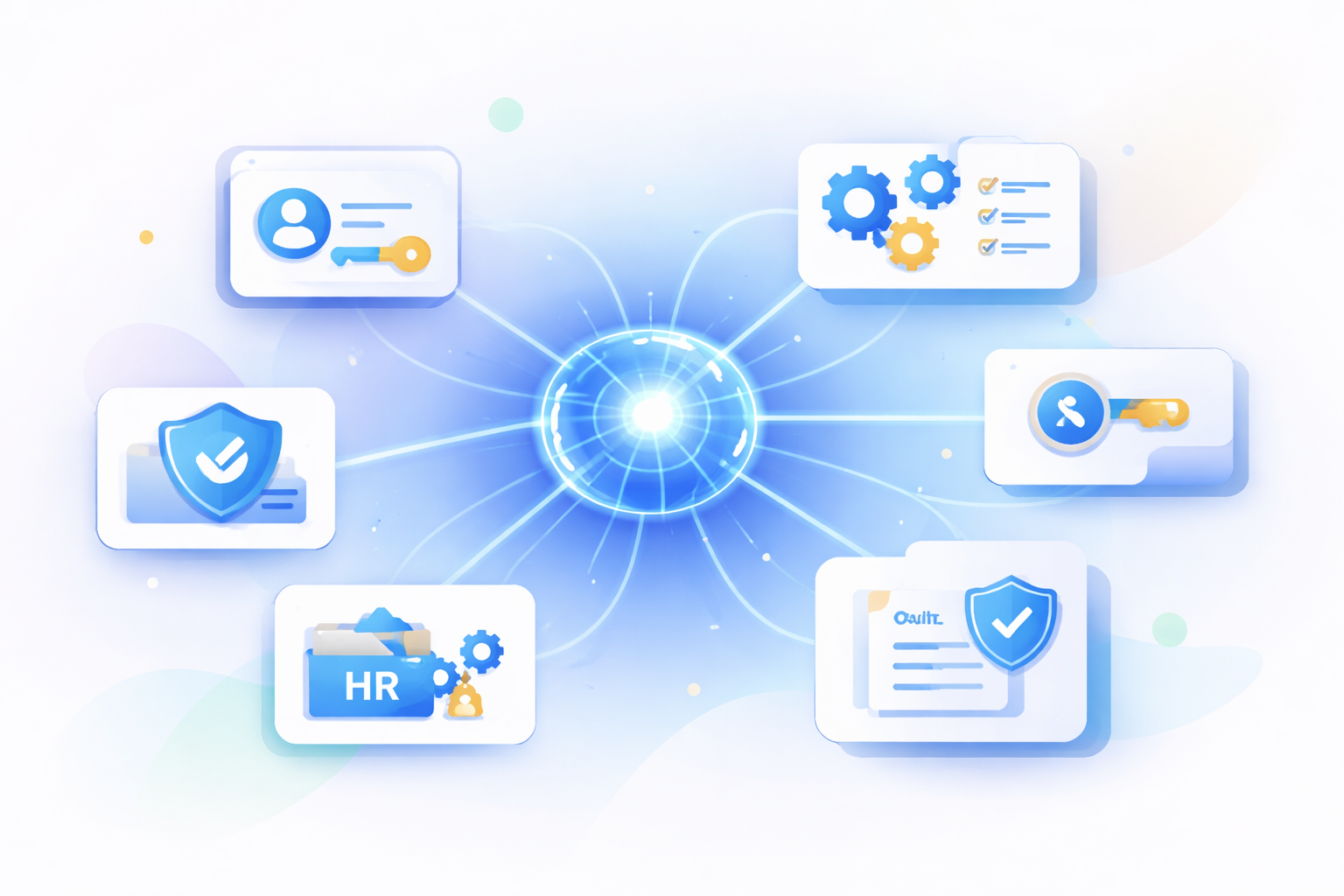
A single AI agent with a holistic view across IAM—apps, identities, access, workflows, approvals, policy, OAuth, and risk—becomes materially more powerful than a collection of siloed agents. Not because it’s bigger or more complex, but because it can connect the dots the way an experienced IAM operator does.
This post explains why that matters and what it unlocks for an IAM admin.

The core truth: IAM is an end-to-end system, not a set of tickets
Most of the work you care about lives between systems:
- A user can’t access an app. Is it RBAC policy? Group mapping? Provisioning failure? Approval routing? Unlinked account? OAuth vs SAML? Directory identity risk block?
- A leaver is offboarded. Did access actually get removed? Were there exceptions? Did any OAuth grants remain? Did any unlinked accounts survive? What about non-human identities?
- Drift is exploding. Is it a policy modeling issue, a provisioning regression, a mapping gap, or a new onboarding flow?
When you’re doing this manually, you end up performing the same dance every time:
- Start with a symptom.
- Jump across consoles and tables to gather evidence.
- Reconcile contradictions.
- Form a hypothesis.
- Test it.
- Decide on the least risky remediation.
- Verify the fix.
A siloed agent can only help with step 2 in its own domain. A holistic agent can help with the entire loop.
Why “many specialized agents” breaks down in real IAM ops
Siloed agents create three failure modes that IAM admins feel immediately:
1) They can’t see causal chains
A workflow debugging agent might tell you “tasks are failing,” but can’t explain that the root cause is OAuth permissions revoked for the provisioning connector. An access agent might say “user is missing entitlement,” but can’t correlate that the provisioning pipeline has been erroring since yesterday.
In IAM, the right answer is rarely “the one thing that’s broken.” It’s usually the interaction.
2) They force you to be the integrator
When separate agents disagree, you become the arbitration layer. You’re the one reconciling “policy says yes” vs “account doesn’t exist” vs “workflow failed” vs “approval never triggered.”
That’s exactly the cognitive load you were trying to offload.
3) They duplicate effort and miss the “what next?” step
You don’t just need facts. You need sequencing:
- What do I fix first to reduce risk fastest?
- What’s reversible vs irreversible?
- What can I contain immediately while I work on a durable fix?
- How do I verify we’re back in a good state?
Siloed agents tend to output “their” slice of evidence without turning it into a coherent plan.
What a holistic IAM agent can do that siloed agents cannot
A single agent with end-to-end IAM context can operate like a seasoned IAM admin: it starts with intent (“what are we trying to answer?”), then collects the right evidence across systems, then produces a recommendation that accounts for tradeoffs, blast radius, and verification.
Here are the high-value use cases where that difference shows up.
1) Access triage that actually resolves the issue
The classic ticket: “User can’t access GitHub.”
A siloed access agent might check the access request status. A siloed RBAC agent might evaluate policy. A siloed provisioning agent might check connector health.
A holistic agent can do the full diagnosis:
- What does the user have today?
- What should they have per policy?
- Is there a linked account in the target app?
- Did provisioning run? Did it fail? Where?
- Did an approval route correctly, or is routing misconfigured?
- Is there drift (over/underprovision) for this user/app?
- Is this actually an authentication/IdP issue outside IAM provisioning?
Most importantly: it can classify the failure into actionable categories and recommend the least disruptive path to resolution—then provide a verification loop to confirm the fix.
You get “here’s what’s wrong and what to do,” not “here’s a report.”
2) Joiner/Mover/Leaver programs that don’t rely on heroics
JML is where IAM maturity is proven—and where operational reality is brutal.
A holistic agent becomes a JML quality engine because it can validate outcomes end-to-end:
Joiner
- Identity exists, is mapped correctly, meets posture requirements (e.g., MFA).
- Baseline access is granted as expected.
- Accounts are created and linked in target apps.
- Any workflow failures are surfaced with clear next steps.
Mover
- Expected access changes are identified.
- Old access that should have been removed is flagged.
- Exceptions are documented and traceable.
- Provisioning/approval workflows are verified.
Leaver
- Access is actually removed (not just requested).
- Unlinked accounts are detected and escalated.
- OAuth grants and shadow access paths are identified.
- Non-human identities tied to the person/team are included in the offboarding story.
The value isn’t that the agent “automates offboarding.” The value is that it makes offboarding verifiable and repeatable, and it surfaces exceptions before they turn into audit findings.
3) RBAC that is maintainable, not a one-time project
Effective RBAC is time-consuming for one reason: it’s an iterative control system.
You design policy → reality deviates → you investigate → you adjust policy/process → repeat.
A holistic agent accelerates the loop:
- Quantify drift by reason and blast radius.
- Identify top apps contributing to risk.
- Distinguish: policy gaps vs mapping issues vs provisioning regressions vs true exceptions
- Produce a prioritized remediation backlog.
- Support safe rollouts with before/after verification.
This shifts RBAC maintenance from “painful quarterly cleanup” to an ongoing, manageable operational rhythm.
4) OAuth and Shadow IT triage that connects to governance
OAuth risk is not just “look at scary scopes.” The hard part is:
- Who granted it?
- How many users are impacted?
- Is it tied to a managed app we already govern?
- What’s the containment action that won’t break the business?
- What’s the durable alternative?
A holistic agent can connect OAuth findings to the rest of IAM:
- Is the app managed or unmanaged?
- Do we have an approved integration we can migrate to?
- Do we need approval routing changes?
- Do we need policy changes for safer defaults?
It can turn “here’s a risky OAuth app” into “here’s the path to eliminate it.”
5) Audit readiness as a byproduct of operations
Audits punish fragmentation: evidence lives everywhere, narratives are inconsistent, and exceptions are undocumented.
A holistic agent can generate audit-ready outputs naturally from operational workflows:
- Access review packages (per app, per role, per population)
- Approval routing evidence and effective approver mapping
- Drift reports that prove alignment (or quantify misalignment)
- Identity risk posture (MFA, dormancy, mapping quality)
- Workflow execution evidence (what ran, what failed, what was remediated)
The win is not “faster spreadsheets.” The win is a consistent, evidence-driven story of how access is governed—produced on demand.
The real advantage: it produces decisions, not dashboards
IAM admins don’t need another place to look at data.
They need help deciding:
- What is the most likely root cause?
- What is the safest remediation?
- What is the blast radius?
- What can I do now to contain risk?
- What should I do next to make the fix durable?
- How do I verify we’re back to green?
A holistic agent can answer those questions because it can see the full chain: identity → policy → approval → provisioning → access → drift → risk.
Siloed agents can’t do that reliably, because each sees only one link.
How modern agent systems make “one agent, many workflows” practical
You don’t get a holistic agent by stuffing everything into one giant prompt. That becomes noisy, brittle, and hard to maintain.
Modern agentic harnesses typically use a “skills” approach: the agent keeps a stable core behavior, then loads the right domain playbook on demand—access triage, OAuth investigation, drift remediation, workflow debugging, app posture review, directory risk, approvals, NHI inventory, and so on.
To the IAM admin, the important point is simple:
- You interact with one agent.
- It adapts to many IAM intents.
- It stays consistent in how it gathers evidence and recommends action.
- It doesn’t lose context when the problem crosses domains—because it’s designed to cross domains.
What this means for the IAM admins
A holistic IAM agent becomes:
- Your Tier-2/Tier-3 investigator for access and provisioning issues
- Your RBAC maintenance operator that turns drift into a backlog
- Your JML quality enforcer that makes lifecycle outcomes verifiable
- Your OAuth and Shadow IT triage partner that connects risk to governance
- Your audit assistant that produces evidence packages and consistent narratives
And it does all of this without forcing you to be the glue between multiple bots.
Bottom line
IAM work is not a set of independent tasks. It’s a connected system where the highest-cost problems live at the seams.
That’s why one holistic agent—one that can traverse identity posture, access policy, approvals, workflows, provisioning, app accounts, OAuth, and drift—delivers outsized value compared to a fleet of siloed agents.
It doesn’t just answer questions.
It closes loops.