
Identity governance that stands up to audits
Run audits that show real access, real risk, and real outcomes without chasing tickets or exporting CSVs.
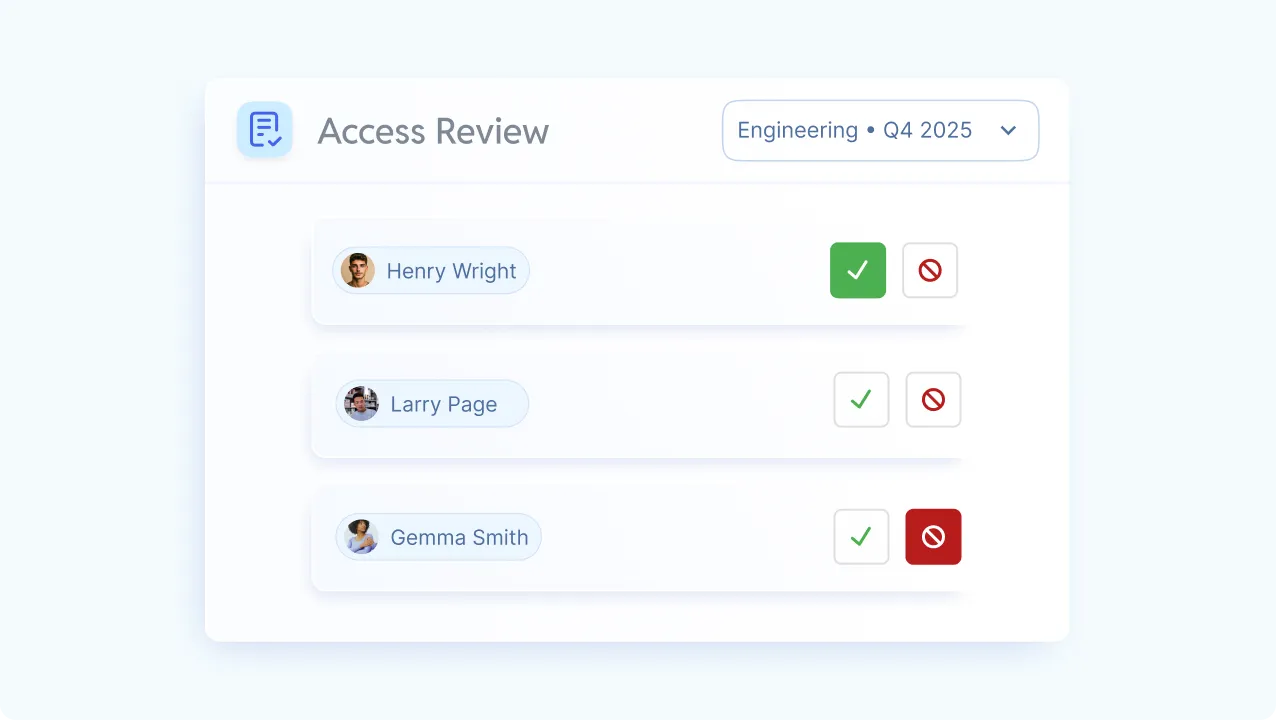
Audits should explain access, not just collect attestations
Access reviews are meant to prove control. In practice, they often become checkbox exercises driven by stale group lists, partial app data, and reviewers who cannot tell what they are approving. Most IGA tools review access as it appears in directories or roles, not how access actually exists inside applications. That gap forces security teams to over-review, under-review, or manually reconcile results later. YeshID fixes this by auditing access as it exists, not as it is assumed.
Reviews based on real application access
YeshID audits what users can actually do inside applications, including roles, permissions, scopes, and entitlements. Reviewers see meaningful access context instead of opaque group names or inherited roles. This makes decisions faster and materially improves audit quality.
One review model across automated and manual apps
Not every application supports SCIM or APIs. YeshID runs audits across both integrated and manual systems using the same review framework. Automated apps support direct remediation. Manual apps still produce complete, reviewable records with tracked follow-up actions so nothing disappears after approval.
Policy-aware reviews that highlight drift
Reviews are evaluated against policy. YeshID shows where access aligns with policy and where it has drifted due to exceptions, manual changes, or time-based access that never expired. This turns audits into a control mechanism, not a recurring surprise.
Structured reviewer workflows without email chains
Assign reviewers by role, manager, app owner, or security team. Require justification where needed. Escalate sensitive decisions automatically. Reviewers see what matters to them and nothing more. No spreadsheets. No inbox archaeology.
Built-in remediation, not post-audit cleanup
When access is denied or flagged, YeshID can revoke, downgrade, or expire access directly for integrated apps. For manual systems, required actions are tracked until completion. Audit findings do not end as PDFs. They end as resolved access changes.
Audit trails auditors can actually follow
Every review captures who reviewed access, what decision was made, what policy applied, and what changed as a result. Reports are complete, consistent, and exportable without reconstruction. You can answer auditor questions without reopening the audit or re-running reports.
“No solution really sat between manually managing all of my SaaS and Okta until YeshID came along. Not sure how I could manage my org without it”

