
Identity visibility and effective access
See what every identity can actually reach.
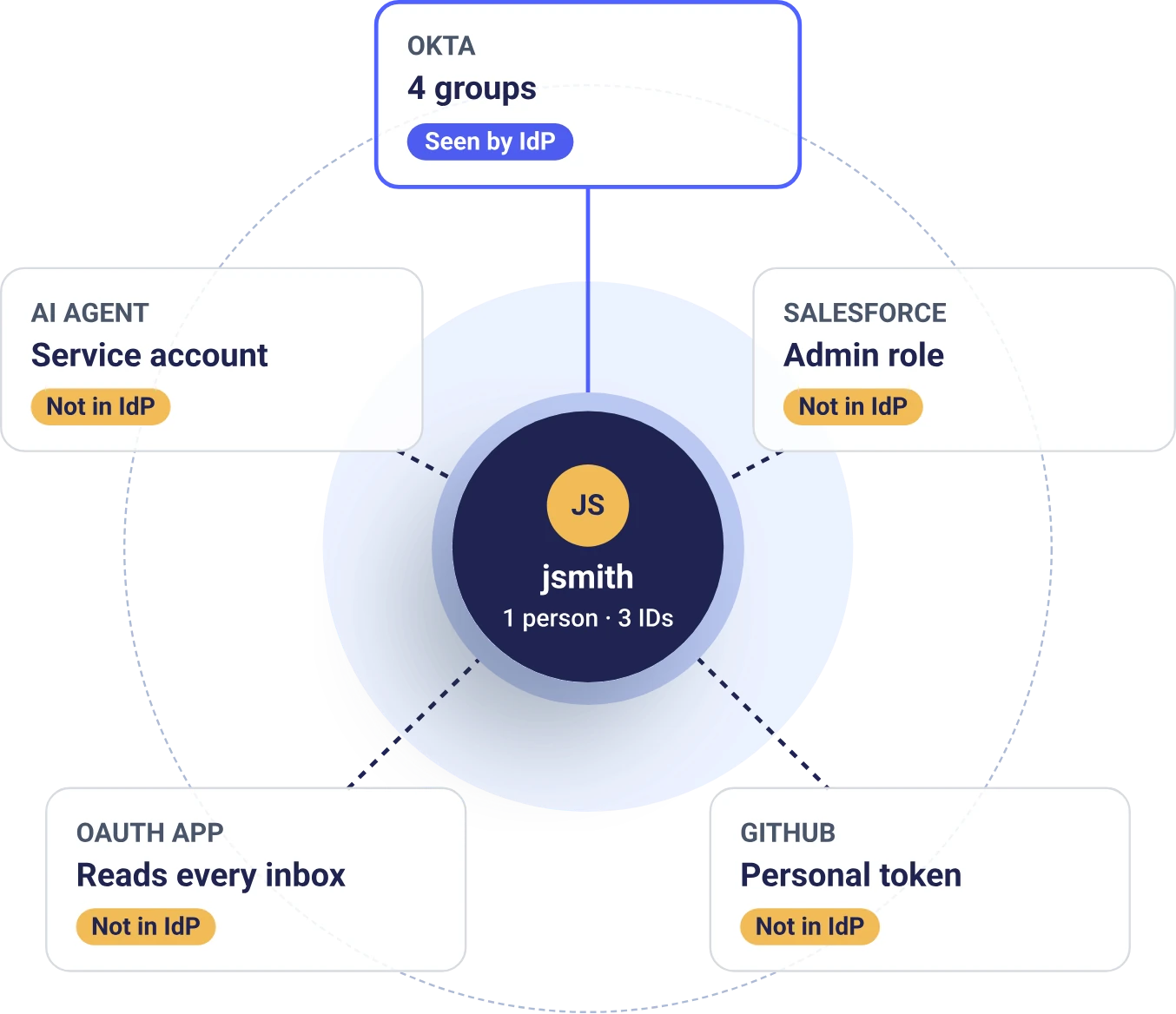
Your IdP knows who logged in. YeshID shows what they can do inside every app, OAuth grant, service account and AI agent.
Identity visibility and effective access
Your IdP knows who logged in. YeshID shows what they can do inside every app, OAuth grant, service account and AI agent.
The problem
Access gets granted everywhere but the IdP.


So “who has access to this?” turns into a week of CSV exports.
Understand Access Capabilities
Effective access is what an identity can actually do, wherever the permission lives.
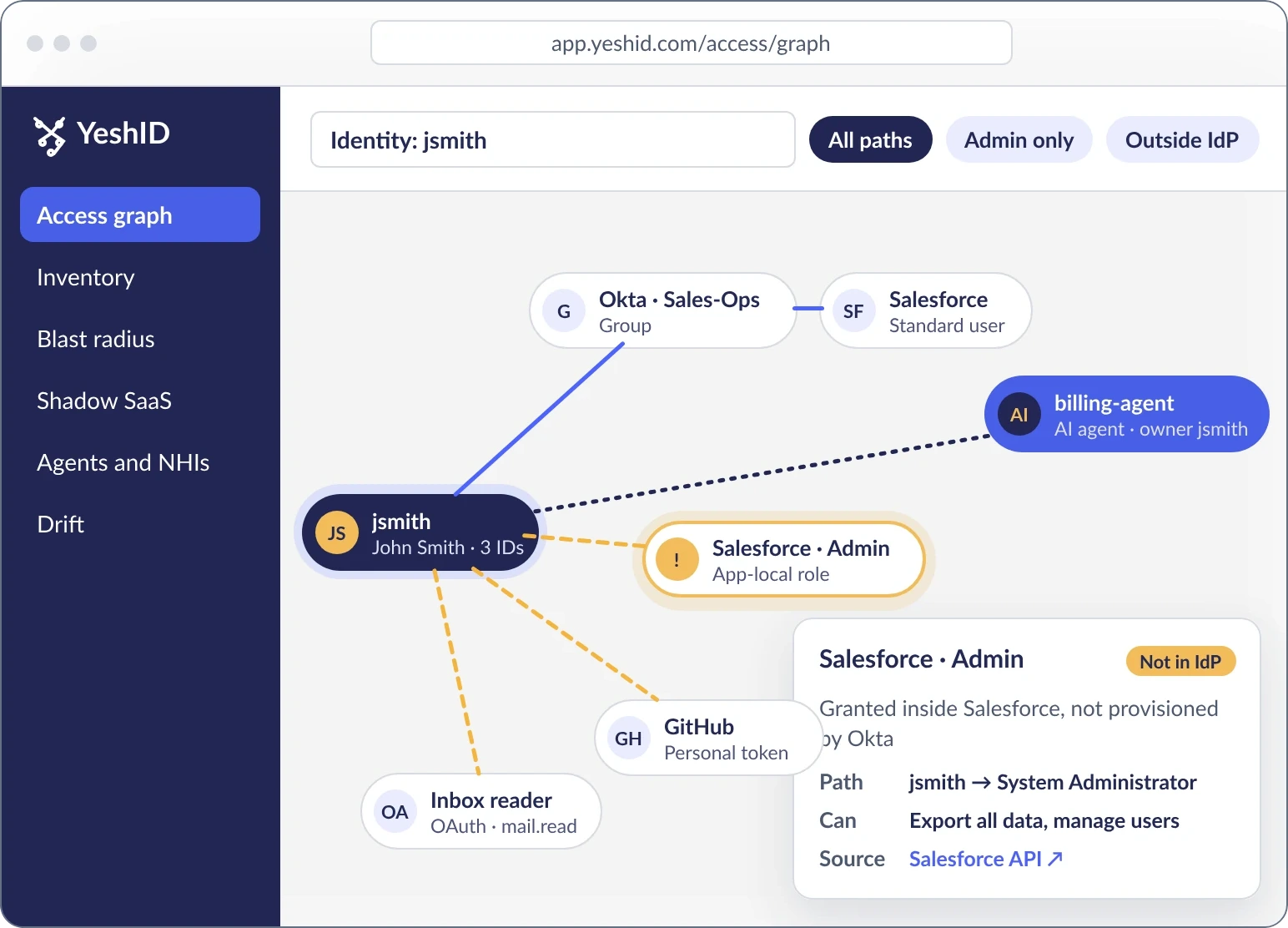

Identities, apps, roles, groups and delegated paths, and how they connect.

Every account, permission and credential, including the ones the IdP never provisioned.

Pick an identity and see everything it can reach, directly or inherited.

Apps employees connected on their own, and what they're allowed to do.

Service accounts, API keys, bots and agents, each tied to an owner or flagged.

Admin and project roles that live inside the app.

Where reality has wandered from policy.
How it works
IdP, HRIS, SaaS and cloud, by API, SCIM or OAuth. Apps with no integration still count.
Roles, scopes, groups and grants, translated into one model.
jsmith, John Smith and a contractor ID become one person. Every non-human identity links to its human owner.
The graph updates as people join, move and leave, and as new grants and agents appear.
Who can export customer data? Which OAuth apps read every inbox? Every answer traced to its source.
Use cases

A user gets phished. Know in minutes what the account, and every token it issued, can reach.

Confirm access is gone across apps and grants, not just disabled in the IdP.

Find broad-scope apps that were approved once and never reviewed.

Answer "who has access to X" with a current, sourced answer.

Know which agents exist, what they touch and who owns them.
Other vendors sell separate products for people and non-human identities. YeshID puts both on one graph, so every agent and service account traces back to a person.
The riskiest access lives in the app with no SCIM, the admin role inside one tool, the OAuth grant from 2022. YeshID connects to all of it.
No dashboard bragging about 1,000 shadow apps. Just the ones that matter, ranked by what they can do.
Something else on your mind? Talk to our team.
Understand Access is YeshID's visibility layer: one continuously updated graph of effective access across people, service accounts, OAuth grants and AI agents.
Effective access is what an identity can actually do across your systems, not just what your IdP says. It includes app-local roles, OAuth scopes, nested groups and delegated access.
Your IdP manages sign-in and the groups it provisions. It can't see roles created inside apps, OAuth grants between apps, or credentials created outside it.
No. YeshID runs alongside Okta, Entra, Ping, JumpCloud or Google Workspace.
Yes. Non-human identities sit on the same graph as people, each linked to an owner.
They're included. The long tail is where access hides, so it's part of the graph.
It updates continuously as access changes, not on a quarterly export.