

Access remediation and deprovisioning
Close the gap between policy and reality.
When access drifts, YeshID fixes it. Revoke, expire and deprovision across every app, inside guardrails you set.
Access remediation and deprovisioning
When access drifts, YeshID fixes it. Revoke, expire and deprovision across every app, inside guardrails you set.
The problem


Control Access Capabilities

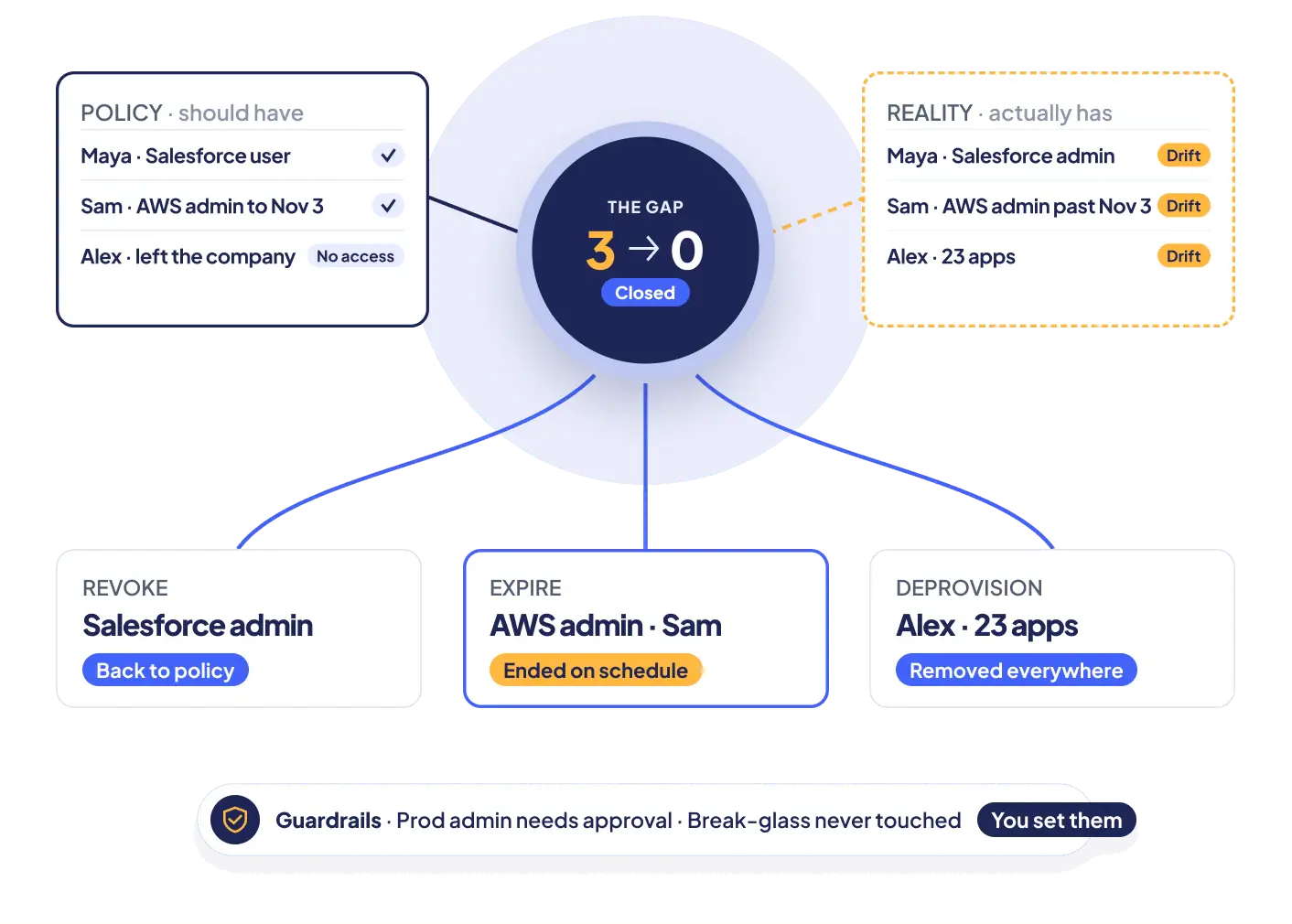
YeshID compares effective access to policy and acts on the difference.

Access that drifted gets brought back in line, automatically or with approval.

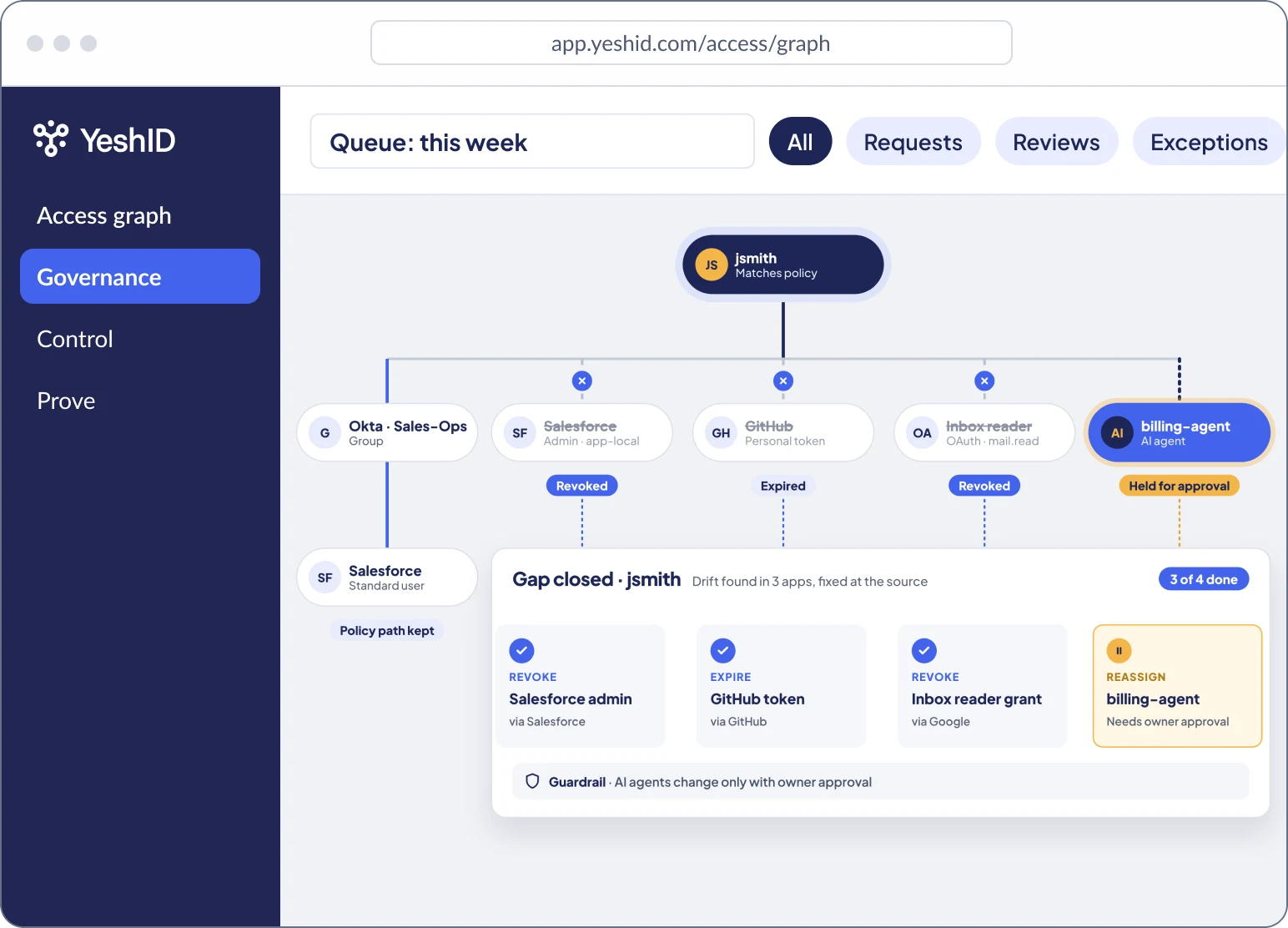
When someone leaves, access comes off everywhere: IdP, SaaS, app-local roles and OAuth grants. API keys and tokens they created come up for review, so you decide: delete them or reassign them.

JIT and exception access ends on schedule.

Pull risky or unused app grants, one at a time or by policy.

Non-human identities with no owner or no recent use get reassigned or retired.

Trim access people have but don't use.

Keep AI agents inside approved scopes, and pull access when the owner leaves.
How it works
YeshID finds the gap between effective access and policy.
Your policy picks the response: fix it, ask first or alert.
Through API or SCIM, or a tracked task with a named owner for apps with no integration.
YeshID re-checks the source. Confirmed, not assumed.
The full trail lands in Prove Access.
Use cases


Every app and grant removed and verified. Every key and token reviewed, then deleted or reassigned.
A compromised identity gets cut off across everything it can reach, not just the IdP session.
Lock a departing employee's laptop or act in any endpoint tool with an API, from the same workflow.
An app that can read every inbox gets revoked without waiting for a ticket.
The owner left last spring. The account gets reassigned or retired.
An AI agent with more scope than its job needs gets trimmed back to policy.
Most platforms only act where SAML or SCIM reaches. Rae builds the integration for anything with an API. No API? A named owner, tracked to closure.
Deprovisioning that “probably worked” isn't control. YeshID re-checks the source.
Automatic, with approval, or alert only, per policy, app and identity type. Rae separates understanding from execution, and every action follows the same approvals as any identity operation.
Something else on your mind? Talk to our team.
Control Access is YeshID's enforcement layer: it closes the gap between policy and effective access across every app, then verifies each change at the source.
Only where you've told it to. You decide per policy what's automatic and what needs a human.
YeshID creates a task for a named owner and treats the access as open until it's confirmed removed.
Yes, one at a time or by policy, in platforms like Google Workspace and Microsoft 365.
YeshID covers the identity side of detection and response: it shows what a compromised identity can reach and removes that access across every app.
Yes. Agents get the same ownership, scoping and deprovisioning as any other identity.
Control that reaches every identity, human and agentic.